
Dr. Chaitanya Vemu’s Eye Clinic



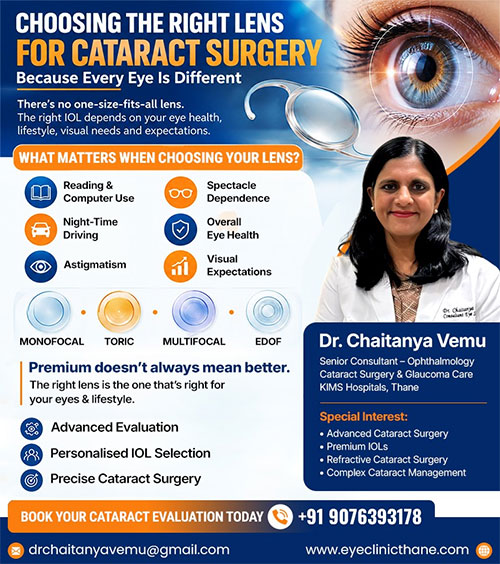
Choosing the Right Lens for Cataract Surgery: Why One Size Doesn't Fit All
When patients are told they need cataract surgery, one of the first questions they ask is:
"Which lens should I choose?"
The truth is that there is no single "best" lens for everyone.
Modern cataract surgery involves replacing the cloudy natural lens with an artificial intraocular lens (IOL). Today, several types of IOLs are available, including monofocal, toric, multifocal, and extended-depth-of-focus (EDOF) lenses. The most suitable lens depends on the individual patient's visual needs and lifestyle.
Cataract Surgery Is About More Than Removing the Cataract
Lens selection is an important part of achieving the best possible visual outcome after surgery.
When advising patients, I consider factors such as:
-
Age and lifestyle
-
Reading habits
-
Computer and mobile phone use
-
Driving requirements, especially night driving
-
Desire to reduce dependence on spectacles
-
Presence of astigmatism or other eye conditions
-
Budget and affordability
For example, someone who spends hours reading may have different requirements from someone who drives frequently or spends most of their day on digital screens.
Premium Lenses Are Not Necessary for Everyone
One of the biggest misconceptions is that the most expensive lens is automatically the best option.
In reality, the ideal lens is the one that matches your expectations and daily visual demands. Excellent outcomes can be achieved with different categories of lenses, and there are quality options available across a wide range of budgets.
My goal is never to recommend the costliest lens. My goal is to recommend the lens that is most appropriate for you.
Advanced Evaluation Makes the Difference
Choosing the right lens requires precise measurements and a detailed eye examination.
At KIMS Hospitals, Thane, we use advanced diagnostic technology to evaluate patients for standard as well as premium IOLs, helping customise surgery according to individual visual goals.
Expertise Matters, Especially in Complex Cataracts
While routine cataract surgery is highly successful, some patients present with dense, mature, diabetic, post-traumatic, or otherwise complicated cataracts.
Having performed a large number of cataract surgeries over the years, including many challenging cases, I understand the importance of meticulous planning, surgical precision, and personalised care to achieve the best possible results.
Frequently Asked Questions
Which is the best lens for cataract surgery?
There is no universal "best" lens. The right lens depends on your eye condition, lifestyle, visual expectations, and budget.
Can I become spectacle-free after cataract surgery?
Many modern IOLs can reduce dependence on spectacles for daily activities. The degree of spectacle independence varies from person to person.
Are premium lenses worth considering?
For suitable candidates, premium lenses can provide additional visual benefits. A detailed evaluation is needed to determine whether they are the right choice.
How do I know which lens is right for me?
A comprehensive eye examination and a discussion about your daily activities and expectations help determine the most suitable lens option.
Can complicated cataracts be operated safely?
Yes. With proper planning, advanced technology, and experienced surgical expertise, even many complex cataracts can be managed successfully.
A Personal Note
Every eye is unique, and every patient has different visual goals. My role is not just to remove a cataract, but to help patients choose a lens that complements their lifestyle and daily activities. A thoughtful pre-operative evaluation and honest discussion often make all the difference to the final outcome.
Dr. Chaitanya Vemu
Senior Consultant - Ophthalmology
(Specialist - Cataract surgery, & Glaucoma care)
KIMS Hospitals, Thane
Special Interest: Advanced Cataract Surgery, Premium IOLs, Refractive Cataract Surgery & Complex Cataract Management